

FINE ART PHOTOGRAPHY OF 24K GOLD · NISSAN SILVIA S15 LB SUPER SILHOUETTE · LUXCAST #205
An Aerodynamic Sketch with the Volume Turned Up
On this Silvia, every plane has something to announce.
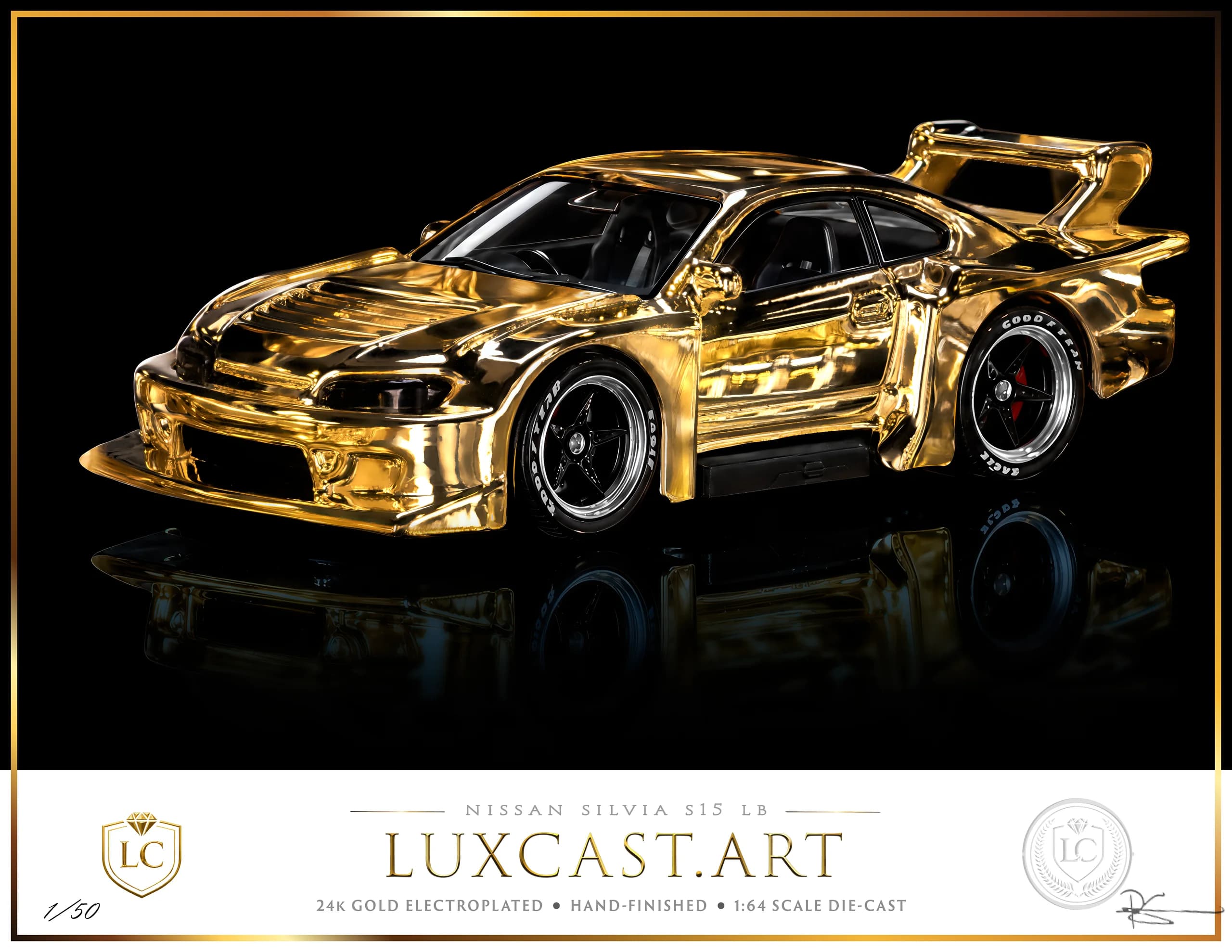
This Silvia has enough arches, wings and angular transitions to keep a photographer occupied for a week. That is both the attraction and the trap. If every piece shouts at equal volume, none of the bodywork gets heard. The challenge is to give the viewer a route through the design.
A Lens Can Change the Weight of a Wing
Stand low and close to the gold Silvia and its broad front splitter dominates the view; step back and the rear wing claims more attention. That is perspective—the relationship between distance and apparent size—not a change to the casting. In the finished Luxcast photograph the front splitter fills the lower-left foreground, a black wheel anchors the center, and the gold rear wing rises into the right edge. The camera has composed an argument between front and back. The bodywork is already extravagant enough.
Geometry as Graphic Art
Just behind the front wheel in the Luxcast image, a large gold fender extension drops into a dark vertical opening. That dark slot gives the side a second focal point after the front splitter. Follow it and the eye reaches a deep-black wheel, then a surprisingly smooth side window, then the high wing. The kit is not one large shape; it is a series of planes separated by shadow. At this scale the separation is more revealing than a heroic claim about speed.
Liberty Walk lists a front bumper, wide fenders, side skirts, rear diffuser, bonnet and wing among the parts of its S15 conversion. On the photograph, those categories become visible changes of direction: horizontal blade under the nose, nearly vertical cut behind the wheel, then an elevated wing plane at the tail.
The Difference Between Paint and Reflection
Full-size tuner cars frequently use complex graphics and racing liveries to announce their personality. An electroplated miniature changes that relationship. Instead of relying on contrasting painted panels, it may use reflections and differences in surface direction to separate features.
A sharp corner can snap a highlight into darkness. A broad side panel can become a mirror of the studio. The result emphasizes the underlying geometry.
The most surprising contrast is material, not scale. The black racing wheels refuse to participate in the broad warm reflections running across the fenders. They give the camera dark punctuation at the exact points where the rest of the body threatens to become a single gold ribbon. Those interruptions help a radical silhouette remain legible rather than visually overwhelming.
When a silhouette is this loud, a good photograph doesn't need to turn the volume up. It needs to make the music intelligible.